

Divorce is one of the most complex legal transitions an individual can face, particularly in New York where equitable distribution laws dictate asset division. According to recent demographic data, the average divorce in New York State involves significant financial entanglements that require precise legal navigation to ensure fair outcomes. This guide provides a comprehensive overview of the divorce process, legal options, and strategic considerations for residents of Suffolk County, Nassau County, and Manhattan.
Understanding New York Divorce Law
New York is an equitable distribution state. This means that marital property is divided fairly, but not necessarily equally, between spouses. Equitable distribution is the legal framework used by New York courts to determine how assets and debts are split during a divorce. The court considers various factors, including the duration of the marriage, the age and health of both parties, and their future financial prospects.
For residents of Suffolk County, understanding these laws is critical. The local courts have specific procedural requirements that can impact the timeline and cost of your case. The Meyers Law Group has been practicing family law since 2003, providing clients with the necessary tools to navigate these complexities. We serve clients throughout Suffolk, Nassau, and Manhattan, ensuring that local nuances are addressed in every case.
Equitable distribution is not just about splitting bank accounts. It includes real estate, retirement accounts, business interests, and even future earning potential. A skilled attorney can help identify all marital assets and ensure that your share is protected. For more information on our approach to equitable distribution, visit our Equitable Distribution page.
Grounds for Divorce in New York
New York law allows for both no-fault and fault-based divorces. Choosing the right ground can significantly impact the outcome of your case, particularly regarding alimony and asset division.
No-Fault Divorce
The most common path is the no-fault divorce, based on irretrievable differences. Irretrievable differences is a legal ground for divorce stating that the relationship has broken down for at least six months. This option is often preferred because it avoids the need to prove wrongdoing, which can reduce conflict and legal costs. It allows couples to focus on settlement rather than blame.
Fault-Based Divorce
Fault-based grounds include adultery, cruelty, and abandonment. Adultery is a specific fault ground that can influence alimony awards. Cruelty involves physical or mental harm that makes it unsafe to live together. Abandonment occurs when one spouse leaves the marital home without justification for a continuous period of one year.
Choosing between no-fault and fault grounds requires careful strategic planning. Our team at Contested Divorce services can help you determine which path aligns best with your goals. For a deeper dive into these legal grounds, read our article on Legalization of Same Sex Marriage impacts on divorce rights.
The Divorce Process: Step by Step
Understanding the procedural steps can help reduce anxiety and set realistic expectations. The divorce process in New York typically follows a structured timeline.
1. Filing the Summons and Complaint
The process begins with one spouse filing a Summons and Complaint with the county clerk. This document outlines the basic facts of the marriage, the grounds for divorce, and the relief sought, such as custody or support. Filing is the first formal step in initiating legal proceedings.
2. Service of Process
The other spouse must be formally served with the legal documents. Service of process ensures that the respondent is aware of the lawsuit and has an opportunity to respond. If the spouse cannot be located, alternative methods like publication may be required.
3. Response and Discovery
The respondent has a set period to file an Answer. Discovery follows, where both parties exchange financial information, documents, and interrogatories. Discovery is the phase where facts are gathered to support claims regarding assets and liabilities.
4. Settlement Negotiations or Trial
Most cases are resolved through settlement negotiations or mediation. If an agreement cannot be reached, the case proceeds to trial. Trial is the final stage where a judge makes binding decisions on unresolved issues. For guidance on navigating these stages, explore our Divorce Litigation resources.
Mediation vs. Litigation
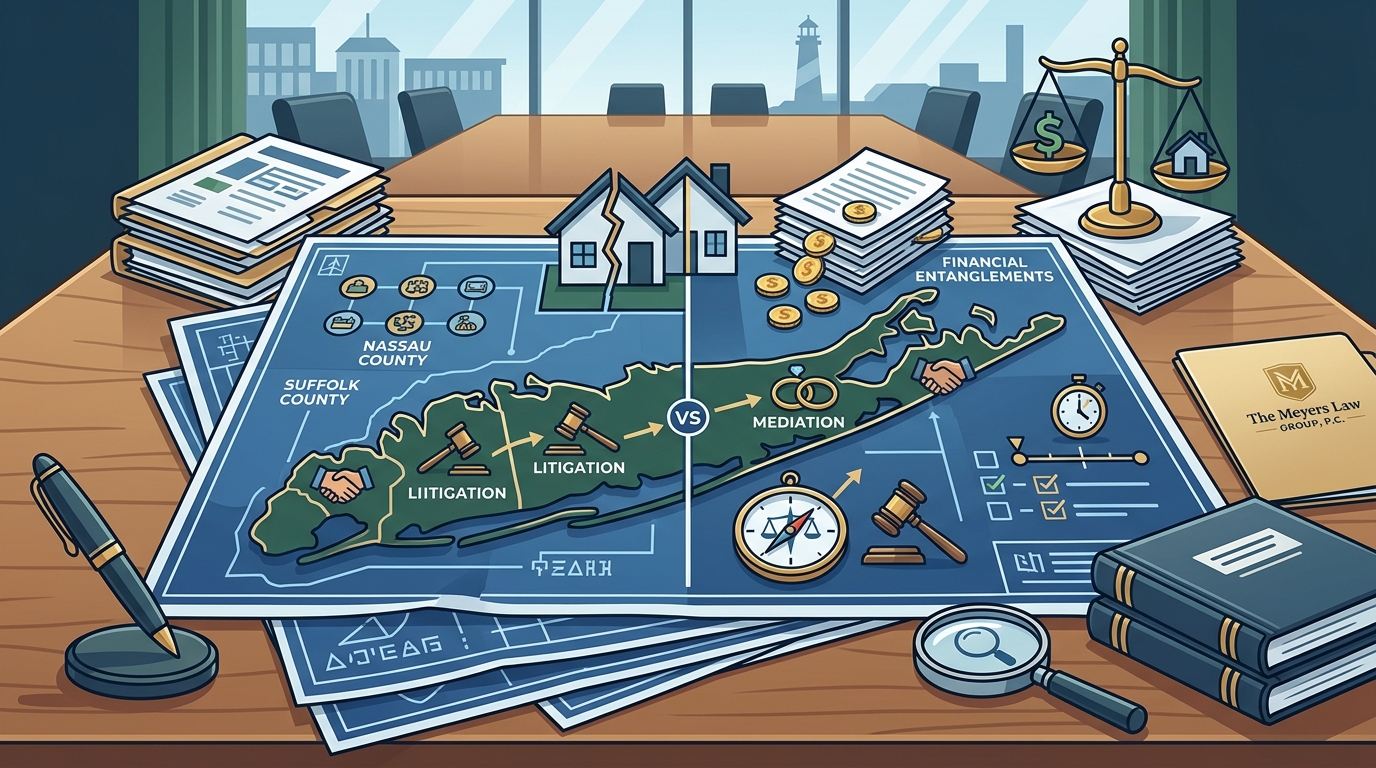
Choosing between mediation and litigation is one of the most important decisions in a divorce. Each path has distinct advantages and disadvantages depending on the level of conflict and the complexity of the assets.
| Feature | Mediation | Litigation |
|---|---|---|
| Control | High. Parties decide the outcome. | Low. Judge decides the outcome. |
| Cost | Generally lower. | Can be significantly higher. |
| Privacy | Private proceedings. | Public record. |
| Timeline | Often faster. | Can be lengthy due to court schedules. |
| Conflict | Collaborative approach. | Adversarial approach. |
Mediation is ideal for couples who wish to maintain control over the settlement terms. It is often less stressful and more cost-effective. However, if there is a power imbalance or history of domestic violence, litigation may be necessary to protect your rights. We offer specialized Family Law Mediation services to help couples reach amicable resolutions.
High Net Worth Divorce Considerations
High net worth divorces involve complex financial assets that require specialized expertise. These cases often include business interests, stock options, international assets, and intricate tax implications. High net worth divorce is a specialized area of family law that demands meticulous financial analysis.
Valuing a business is often the most contentious issue in these cases. Discrepancies in valuation can lead to significant disparities in the final settlement. Our firm has extensive experience in High Net Worth divorce cases, ensuring that your financial interests are fully protected. We work with forensic accountants and valuation experts to uncover hidden assets and ensure accurate valuations.
For those in same-sex relationships, the legalization of same-sex marriage has opened new avenues for legal protection and divorce rights. Understanding these nuances is critical for equitable outcomes. Learn more about our Same-Sex Divorce services.
Child Custody and Support
When children are involved, the court's primary focus is the best interests of the child. Best interests of the child is the legal standard used to determine custody and visitation arrangements. This standard considers factors such as the child's relationship with each parent, the child's wishes, and the parents' ability to provide a stable environment.
Custody Types
Legal custody refers to the right to make major decisions about the child's education, healthcare, and religious upbringing. Physical custody determines where the child lives. Joint legal custody is common, allowing both parents to participate in decision-making. Sole physical custody may be awarded if one parent is deemed unfit.
Child Support
New York uses a statutory formula to calculate child support. The formula considers both parents' income, the number of children, and the cost of healthcare and education. Child support is calculated based on the Income Shares Model, which aims to provide the child with the same standard of living they would have had if the parents remained together. For detailed information on support calculations, visit our Child Support page.
Parental alienation is a serious concern in high-conflict divorces. Parental alienation occurs when one parent manipulates a child to reject the other parent without justification. Our firm takes a firm stance against alienation and advocates for strong Fathers Rights and Mothers Rights.
Key Takeaways
- Equitable Distribution: New York divides marital property fairly, not necessarily equally, based on multiple factors.
- Grounds Matter: Choosing between no-fault and fault grounds can impact alimony and asset division outcomes.
- Mediation Benefits: Mediation offers greater control, privacy, and cost savings compared to litigation.
- High Net Worth Complexity: Business valuations and hidden assets require specialized forensic accounting.
- Child-Centric Approach: Custody decisions are strictly based on the best interests of the child standard.
- Local Expertise: Navigating Suffolk and Nassau County courts requires specific procedural knowledge.
- Experience Counts: The Meyers Law Group has over 20 years of experience in family law.
Frequently Asked Questions
How long does a divorce take in Suffolk County?
The timeline varies based on complexity. Uncontested divorces may take three to six months, while contested cases can take a year or longer due to court schedules and discovery processes.
What is the difference between legal and physical custody?
Legal custody involves decision-making rights for education and healthcare. Physical custody determines the child's primary residence. Both can be joint or sole.
Can I get a divorce if my spouse lives out of state?
Yes, if you meet New York residency requirements. You must have lived in the state for a specific period, typically one or two years, depending on the circumstances.
How is alimony calculated in New York?
Alimony, or maintenance, is calculated using statutory formulas that consider income disparity, duration of marriage, and standard of living. The court has discretion to deviate from the formula in certain cases.
What is a prenuptial agreement?
A prenuptial agreement is a contract signed before marriage that outlines how assets will be divided in the event of divorce. It provides clarity and can protect pre-marital assets.
Do I need a lawyer for an uncontested divorce?
While not legally required, having a lawyer ensures that your rights are protected and the paperwork is filed correctly. Uncontested divorces still require precise legal documentation.
What is parental alienation?
Parental alienation is a situation where a child unjustifiably rejects one parent due to the influence of the other. Courts take this seriously and may adjust custody arrangements to protect the child-parent relationship.
How does same-sex divorce differ from traditional divorce?
The legal process is largely the same, but historical asset accumulation and recognition of the relationship date can present unique challenges that require specialized legal knowledge.
Contact The Meyers Law Group
Navigating divorce requires a partner who understands both the law and the emotional toll it takes. The Meyers Law Group, P.C. is dedicated to providing compassionate, aggressive representation for clients in Suffolk, Nassau, and Manhattan. Whether you need help with Prenuptial Agreements, Domestic Violence protection, or complex litigation, we are here to help.
Do not face this challenge alone. Contact us today for a free consultation. Call us at (631) 496-1484 or contact us online to schedule your appointment. Let us help you move towards a brighter future.