

Divorce is one of the most complex legal transitions an individual can face. In Suffolk County, New York, the process involves strict procedural requirements that can easily derail a case if mishandled. According to recent legal data, over 50% of pro se litigants in family court face significant delays due to incorrect filing procedures. This guide outlines the precise steps to navigate the Suffolk County Supreme Court system effectively. The Meyers Law Group has guided countless clients through these exact hurdles since 2003. Understanding the local rules is the first step toward securing your future.
Residency Requirements and Jurisdiction
Before you can file for divorce in Suffolk County, you must meet specific residency criteria. New York State law requires that at least one spouse has been a resident of the state for a continuous period of one year immediately preceding the filing. If the grounds for divorce occurred in New York, and both parties lived there as husband and wife, the one-year residency requirement may be waived. However, if the grounds occurred outside the state, the one-year rule is strict.
Suffolk County is part of the Second Judicial District. This means your case will be handled by the Supreme Court in Riverhead or Brentwood, depending on your specific town of residence. Filing in the wrong county can lead to immediate dismissal or a transfer of venue, causing costly delays. It is crucial to verify your county of residence before preparing any documents. The Meyers Law Group ensures that every client files in the correct jurisdiction from day one. Visit our About Us page to learn more about our local expertise.
Filing the Summons and Complaint
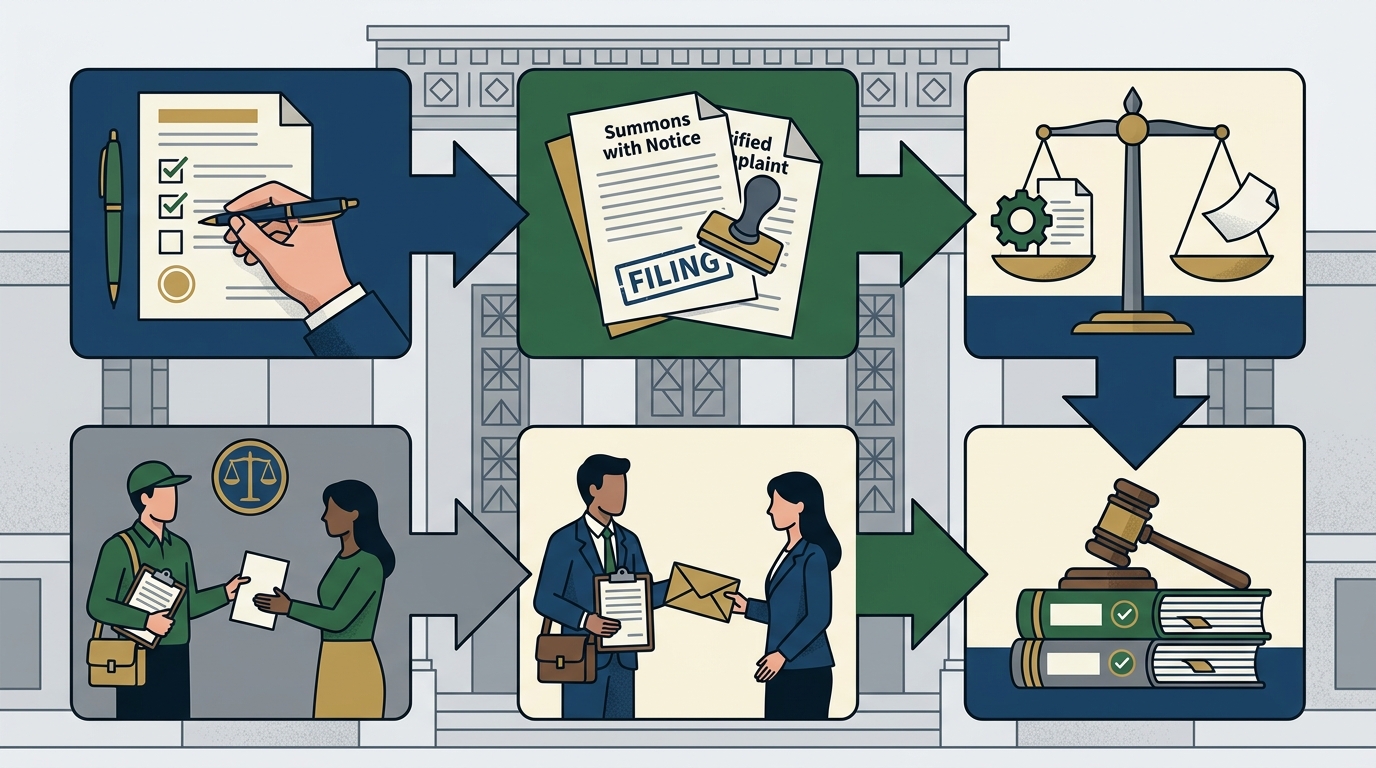
The formal divorce process begins with the preparation and filing of legal documents. You must file a Summons and a Summons with Notice. The Summons notifies the court and the other party that a legal action has begun. The Complaint details the specific grounds for divorce, such as irretrievable breakdown of the marriage for at least six months.
In addition to the Summons and Complaint, you must file a Request for Judicial Intervention (RJI). The RJI is a critical form that assigns a judge to your case and triggers the scheduling of conferences. Without a properly completed RJI, your case will not move forward in the Suffolk County system. The filing fees for these documents are substantial, often exceeding $200. If you cannot afford the fees, you may apply for a waiver of costs. Our team provides detailed checklists for all required forms. Learn about our Divorce Services to see how we assist with document preparation.
Service of Process and Response
Once the documents are filed, they must be legally served to your spouse. In New York, service cannot be done by the plaintiff personally. You must use a disinterested adult, a professional process server, or the sheriff's office. Proper service is vital because it establishes the court's jurisdiction over the defendant. If service is defective, the entire case can be invalidated.
After being served, your spouse typically has 20 days to respond if they reside within New York State, or 30 days if they reside outside the state. The response can be an Answer, which admits or denies the allegations, or a Motion to dismiss. If your spouse fails to respond, you may seek a default judgment. However, default judgments in New York are scrutinized heavily. It is often safer to negotiate a settlement even if the other party is unresponsive. For guidance on handling difficult spouses, read our insights on Fathers Rights.
Financial Disclosure and Discovery
New York is an equitable distribution state. This means that marital property is divided fairly, though not necessarily equally, between the spouses. To achieve a fair division, both parties must fully disclose their financial assets and liabilities. This phase involves the discovery process, where attorneys exchange information through interrogatories, depositions, and subpoenas.
Full financial transparency is required. This includes bank statements, tax returns, retirement accounts, and business valuations. Hiding assets can lead to severe penalties, including the loss of credibility and potential legal sanctions. In high-net-worth divorces, forensic accountants are often hired to uncover hidden wealth. The complexity of financial disclosure varies greatly depending on the assets involved. We specialize in High Net Worth Divorce cases to ensure accurate asset valuation.
Settlement vs. Trial Preparation
Most divorces in Suffolk County are resolved through settlement rather than trial. Settlement conferences are mandatory in New York family court. These conferences are held before a judge who encourages both parties to reach an agreement. If an agreement is reached, it is reduced to a written stipulation of settlement and submitted to the court for approval.
If settlement fails, the case proceeds to trial. Trial preparation is intensive and requires detailed organization of evidence and witness testimony. The burden of proof lies with the party making the claims. In contested divorces, the outcome is unpredictable and often more expensive. Mediation is a viable alternative to trial, offering a neutral third party to facilitate agreement. Our firm offers comprehensive Divorce Mediation to help clients avoid the courtroom.
Obtaining the Final Judgment of Divorce
Once the settlement is approved or the trial concludes, the final step is obtaining the Judgment of Divorce. This document legally ends the marriage and outlines all orders regarding custody, support, and property division. The judgment must be signed by the judge and filed with the county clerk. Only after the judgment is signed is the divorce considered final.
Even after the judgment, issues may arise regarding enforcement or modification. For example, if a spouse fails to pay child support, legal action is required. The Meyers Law Group provides ongoing support to ensure compliance with court orders. Contact us for a Free Consultation to discuss your specific situation.
Key Takeaways
- Residency in New York for one year is a primary jurisdictional requirement for most divorces.
- The Request for Judicial Intervention (RJI) is mandatory to assign a judge in Suffolk County.
- Proper service of process is critical to avoid case dismissal or delays.
- New York follows equitable distribution, not automatic 50/50 division of assets.
- Full financial disclosure is required to prevent legal sanctions and ensure fairness.
- Mandatory settlement conferences are a standard part of the New York divorce process.
- The Judgment of Divorce must be signed by a judge to legally terminate the marriage.
Frequently Asked Questions
How long does a divorce take in Suffolk County?
The timeline varies based on complexity. Uncontested divorces may take three to six months. Contested cases can take a year or longer due to court backlogs and discovery requirements.
Do I need a lawyer for an uncontested divorce?
While not legally required, having an attorney ensures that paperwork is correct and your rights are protected. Errors in uncontested divorces can lead to future legal complications.
What is the difference between legal separation and divorce?
Legal separation allows couples to live apart and resolve financial issues without ending the marriage. Divorce legally terminates the marital status. Legal Separation is an option for those who cannot or choose not to divorce.
How is child custody determined in New York?
Custody is determined based on the best interests of the child. Factors include the parent-child relationship, work schedules, and the child's wishes if they are of sufficient age.
Can I file for divorce if my spouse lives out of state?
Yes, if you meet the New York residency requirements. However, serving your spouse and enforcing judgments can be more complex across state lines.
What is equitable distribution?
Equitable distribution is the legal principle that marital property should be divided fairly based on various factors, not necessarily equally. This concept is central to Equitable Distribution cases.
How much does it cost to file for divorce in Suffolk County?
Filing fees are approximately $210. Additional costs include service of process fees, attorney fees, and potential expert witness costs. Costs vary widely based on case complexity.
Start Your Journey Toward Resolution
Navigating the Suffolk County divorce process requires precision, knowledge, and strategic advocacy. The Meyers Law Group, P.C. has over 20 years of experience helping clients in Suffolk and Nassau Counties achieve favorable outcomes. Do not face this challenge alone. Contact us today to schedule your free phone consultation at (631) 496-1484 or visit our Contact Us page to begin.